Flashforge AD5X vs Bambu P1S: Which to Buy? (November 2026)
Pick the Bambu P1S Combo for most buyers: the enclosed body handles more filaments and the AMS brings up to 16 colors. Choose the Flashforge AD5X if you want a bigger build volume and a lighter open-frame printer.
On this page (10 sections)
- Flashforge AD5X vs Bambu P1S: the two side by side
- The enclosure decides which filaments you can use
- Multi-color: how many colors do you actually need?
- Speed and motion: what the 500 vs 600 mm/s gap means
- Build volume and nozzle choices
- Setup, leveling and daily use
- Who should buy the Bambu P1S Combo?
- Who should buy the Flashforge AD5X?
- Is the four-color AD5X variant worth it?
- Which printer wins the flashforge ad5x vs bambu p1s matchup?
Pick the Bambu P1S Combo for most buyers: the enclosed body handles more filament types and the AMS brings up to 16 colors. The Flashforge AD5X is the better buy if you mostly print single-color models and want a lighter, open-frame printer with a large 220 x 220 x 220 mm build volume.
This flashforge ad5x vs bambu p1s comparison comes down to enclosure, color count and what you print. Both are fast CoreXY machines with automatic bed leveling.
The gap is in how they handle advanced materials and multi-color work.
The P1S Combo costs more and takes more desk space once the AMS is attached. The AD5X stays simpler, but it leaves the print chamber open to room air.
Which trade-off fits you depends on your filament drawer and your projects.

Flashforge AD5X vs Bambu P1S: the two side by side
The P1S line is enclosed and color-ready; the AD5X line is open-frame and speed-focused. Here is how the numbers line up before you weigh anything else.
| Product | Best for | Build volume | Enclosure | Multi-color | Our score |
|---|---|---|---|---|---|
| Bambu Lab P1S Combo | multi-color prints | 15.31 x 18.03 x 15.31 in | Fully enclosed | Up to 16 colors with AMS | 9.1 |
| Bambu Lab P1S | single-color speed | 15.31 x 18.03 x 15.31 in | Fully enclosed | Add AMS for up to 16 colors | 8.8 |
| Flashforge AD5X | large single-color prints | 220 x 220 x 220 mm | Open frame | 8.3 | |
| FLASHFORGE AD5X Multi-Color 3D Printer 4 Colors | four-color starter projects | 220 x 220 x 220 mm | Open frame | Up to 4 colors with IFS | 6.7 |
The P1S and P1S Combo share a 15.31 x 18.03 x 15.31 inch body and weigh about 40.8 and 38.9 pounds. The AD5X and its multi-color sibling both measure 220 x 220 x 220 mm for the build volume, so their build area is a bit smaller per axis than the P1S.
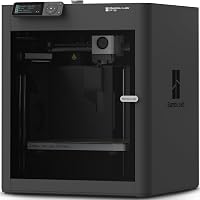
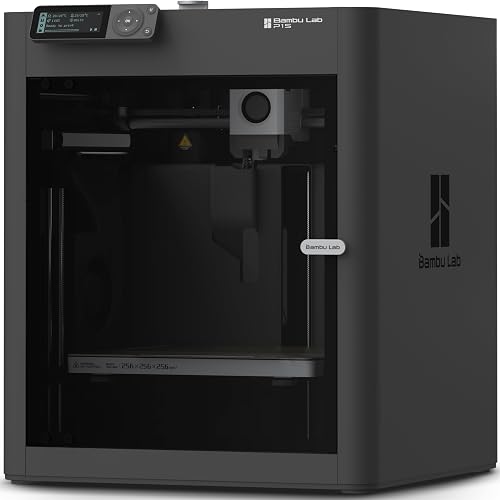
The bigger split is the enclosure. The P1S has a fully closed chamber.
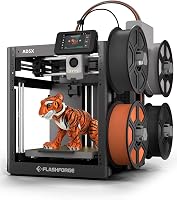
The AD5X has an open frame, so heat escapes around the model as it prints.
Bambu rates the P1S at 500 mm/s and 20,000 mm/s² acceleration. Flashforge rates the AD5X at 600 mm/s and 20,000 mm/s².
Top speed on paper favors Flashforge, but the enclosure changes what you can print at that speed.
Weight tells a practical story too. The two AD5X machines sit around 24 pounds, while the P1S bodies are close to 40 pounds.
The lighter open-frame printer is easier to lift onto a shelf or move between rooms. The P1S's mass comes with the enclosed shell and the stability that goes with it.
The enclosure decides which filaments you can use
If you plan to print ABS, ASA or PC, the P1S is the safer choice. Its closed chamber holds warmth around the model, which matters for materials that shrink as they cool.
Bambu lists PLA, PETG, TPU, PVA, PET, ABS and ASA as ideal for the P1S, with PA and PC as capable. It advises against carbon and glass fiber reinforced polymers.
That gives you a clear map of what to load and what to skip.
Flashforge's material list for the AD5X includes Rapid PLA, Luminous Rapid PLA, Silk PLA, PETG-CF and Rapid PETG. The 300°C direct-drive extruder and dual-channel cooling fan are built around those everyday and specialty PLA and PETG blends.
An open frame doesn't stop you printing PLA. It does mean the room's air touches the part as it cools.
Drafts near a window or an AC vent can affect tall ABS models more than small PLA prints.
If you mostly print PLA decorations, terrain and organizers, the AD5X's open frame is not a problem. If your projects lean toward functional parts in ABS or ASA, pay for the P1S's chamber.
What the filament lists tell you about each printer's focus
Read the two material lists side by side and the design intent shows. Bambu's list runs from PLA up through ABS, ASA, PA and PC, with the warning that carbon and glass fiber reinforced polymers are not recommended.
That is the profile of a machine meant to handle engineering-adjacent materials inside a controlled chamber.
Flashforge's list for the AD5X stays in the PLA and PETG family. Rapid PLA, Luminous Rapid PLA and Silk PLA are finish-focused blends, and PETG-CF and Rapid PETG cover functional and fast-print jobs.
The 300°C extruder leaves headroom for those blends, but the open frame is the limiting factor once you move to warping materials.
Multi-color: how many colors do you actually need?
The P1S Combo gives you up to 16 colors through the AMS; the AD5X tops out at four. The right count depends on whether color is a feature or the whole point of your prints.
The P1S Combo ships with the AMS, Bambu's multi-color unit. The printer supports up to 16 colors once the AMS is connected.
That leaves room for full color palettes, support material swaps and multi-material models in one job.
The plain P1S can also reach 16 colors, but only with an AMS attached, so the Combo is the value route if color matters. The Bambu Lab P1S review walks through the enclosed printer's day-to-day use if you are still deciding between the two boxes.
The base Flashforge AD5X supports up to four colors at once. The FLASHFORGE AD5X Multi-Color variant adds the Intelligent Filament System, which detects and refills filament and also manages four colors.
Both Flashforge machines land well short of 16.
Four colors covers most painted-looking prints, mascots and simple signs. Sixteen colors is more useful when you want gradients, character models or separate support filament without manual spool swaps.
The practical cost of more colors
Color count affects more than the model. Each additional color means more filament changes per layer, and every change costs time and a little material.
A 16-color AMS setup rewards you when a model genuinely uses a wide palette, and it wastes time when the model only needs two colors.
That is why the four-color AD5X variant suits simple multi-color signs and mascots. Four slots keep changes manageable.
The P1S Combo's 16 slots only pay off when your designs actually call for that range.
Speed and motion: what the 500 vs 600 mm/s gap means
Flashforge claims the higher top speed, but the P1S's enclosed frame is built to hold accuracy at its rated 500 mm/s. Treat both numbers as ceilings, not averages.
The AD5X runs on a CoreXY structure with a stable all-metal frame. Flashforge says vibration compensation and a dual-channel cooling fan help it hold quality at speed.
That combination suits rapid prototyping and batch work.
Bambu's P1S uses the same 20,000 mm/s² acceleration figure and pairs its 500 mm/s rating with an enclosed body. A closed frame is stiffer and shields the part from room drafts, which can help when you push speed on tall models.
Neither rating tells you the print time for your model. Layer height, wall count, infill and cooling all change the result.
A 600 mm/s printer can still be slow on a detailed miniature with fine layer heights.
For batch production of simple parts, the AD5X's speed claim is attractive. For a mix of fast drafts and slower display prints, the P1S's enclosed frame is the more useful base.
Build volume and nozzle choices
The AD5X and its multi-color sibling give you four nozzle sizes; the P1S line sticks to the enclosed body's standard setup. Build volume is close enough that nozzle choice matters more.
All four printers here sit in a similar class for build size. The P1S's 15.31 x 18.03 x 15.31 inch figures and the AD5X's 220 x 220 x 220 mm figures are within reach of each other for most models.
Neither is a large-format machine for helmets or full-size props.
Where the AD5X pulls ahead is nozzle flexibility. Flashforge lists four sizes from 0.25 mm to 0.8 mm.
The 0.4 mm nozzle comes pre-installed, and you can fit the 0.25 mm for miniatures or the 0.6 and 0.8 mm for large, sturdy models.
If you print a mix of fine detail and big functional parts, that range saves time. You swap nozzles rather than changing printers.
The P1S ships as a ready-to-use machine with auto bed leveling. Its strength is consistency out of the box, not nozzle swaps.
Buyers who want one printer to do fine work and big work will find more to like in the AD5X's nozzle list.
Setup, leveling and daily use
Both printers level the bed automatically; the P1S is the quicker start and the AD5X adds remote monitoring through its app. The difference is how much tinkering you want.
Bambu says the P1S sets up in about 15 minutes. Auto bed leveling handles the first-layer calibration, so you can print soon after unboxing.
That short start matters if you want the printer working the same day it arrives.
Flashforge's AD5X also has 1-click auto leveling and automatic filament feeding and retraction. It adds power-loss resume, so a print can continue after an unexpected outage.
You can also monitor and control prints remotely through the Flash Maker mobile app.
The P1S line's smart features live in Bambu's own ecosystem. The AD5X's app control is handy if you like checking a print from another room.
Power-loss resume is a real benefit in areas with unreliable power.
Neither printer is a kit build. You assemble, level and load filament, then start printing.
The P1S's 15-minute claim is the shorter of the two, though the AMS adds a step when you set up the Combo.
Who should buy the Bambu P1S Combo?
Buy the P1S Combo if you want one printer for color work and advanced filaments. It is the best overall pick in this matchup and the one most readers should choose.
The enclosed body makes ABS and ASA practical. The AMS brings 16 colors without a separate purchase.
Auto bed leveling and the 15-minute setup keep the first week easy.
Pick the Combo over the plain P1S when color is part of your plan. Pick the plain P1S when you print single-color and want the enclosed body at a lower starting cost.
The Elegoo Centauri Carbon vs Bambu P1S comparison is worth a read if you are still weighing enclosed printers from other brands.
Who should buy the Flashforge AD5X?
Buy the AD5X if you want a fast open-frame printer for PLA and PETG and you rarely need more than four colors. It is the best pick for large single-color projects and buyers who like nozzle flexibility.
The 220 x 220 x 220 mm build volume and 600 mm/s speed suit batch production and rapid prototyping. The 0.25 to 0.8 mm nozzle range lets you switch between fine detail and fast, sturdy prints.
Power-loss resume and app control add convenience.
Skip it if your filament plans include ABS or ASA at any volume. The open frame leaves the chamber exposed, and the P1S's enclosure is the better base for those materials.
For a closer look at the brand's simpler line, the AD5X vs Adventurer 5M comparison covers the trade-offs.
Is the four-color AD5X variant worth it?
The FLASHFORGE AD5X Multi-Color variant is the cheaper way into four-color printing, but the P1S Combo gives you more colors for the money. It is the best pick for a first color printer on a budget.
Its Intelligent Filament System manages up to four colors and detects and refills filament. The CoreXY frame, 600 mm/s speed and 220 x 220 x 220 mm build volume match the base AD5X.
Fully auto leveling keeps the start simple.
The limits are clear. Four colors is fewer than 16.
The open frame rules out the advanced filament comfort of the P1S. If you mostly print single-color models with an occasional two- or three-color sign, it covers the job.
If color is central to your work, the P1S Combo is the stronger long-term buy. Its AMS supports up to 16 colors and the enclosed chamber handles a wider material list.
New buyers weighing brands in general can start with the Bambu Lab vs Flashforge brand comparison.
Which printer wins the flashforge ad5x vs bambu p1s matchup?
The Bambu P1S Combo wins for most buyers, and the AD5X wins for open-frame speed and nozzle range. The deciding questions are which filaments you print and how much color you need.
Pick the P1S Combo if your projects include ABS or ASA and you want up to 16 colors in one machine. Pick the plain P1S if you print single-color and want the enclosed body without the AMS.
Pick the AD5X if PLA and PETG are your main materials and you want 600 mm/s speed plus 0.25 to 0.8 mm nozzles. Pick the four-color AD5X variant if a four-color starter setup matters more than material range.
Either way, match the printer to your filament drawer first. An enclosed chamber you never use costs extra, and an open frame you fight with ABS costs time.
If you are new to the hobby and still comparing brands, the beginner brand guide helps you sort the options.
Frequently asked questions
Is the Bambu P1S worth it over the Flashforge AD5X?
For most buyers, yes. The P1S Combo's enclosed body opens up ABS, ASA, PA and PC filaments, and the AMS reaches up to 16 colors.
The AD5X makes more sense if you print single-color models and want its 220 x 220 x 220 mm build volume.
How many colors can each printer handle?
The Flashforge AD5X supports up to four colors at once, and the FLASHFORGE AD5X Multi-Color variant does the same with its Intelligent Filament System. The Bambu P1S Combo reaches up to 16 colors when the AMS is connected; the plain P1S needs an AMS added to match that.
Does the Flashforge AD5X have an enclosure?
No. The AD5X is an open-frame CoreXY printer.
The Bambu P1S has a fully enclosed body, which helps when you print materials that warp or need steady chamber temperatures.
Which printer is faster, the AD5X or the P1S?
The Flashforge AD5X is rated at 600 mm/s with 20,000 mm/s² acceleration. The Bambu P1S is rated at 500 mm/s with 20,000 mm/s² acceleration.
The AD5X posts the higher top speed on paper, but real print times depend on the model and settings.
Can I print engineering filaments on either printer?
The Bambu P1S lists PLA, PETG, TPU, PVA, PET, ABS and ASA as ideal and PA and PC as capable. Flashforge's AD5X material list includes Rapid PLA, Silk PLA, PETG-CF and Rapid PETG.
Check each filament against the printer's stated limits before buying.
How long does setup take?
Bambu says the P1S sets up in about 15 minutes. Flashforge doesn't publish a setup time for the AD5X in the data we have.
Plan an evening for either printer if you are new to CoreXY machines and filament changes.