Resin vs Filament 3D Printer for Miniatures: Which Is Better? (November 2026)
Pick a resin printer for crisp miniature detail and a filament printer for tough, budget-friendly terrain. In this resin vs filament 3D printer for miniatures comparison, the right choice comes down to what you print and how much post-processing you'll accept.
On this page (9 sections)
- Resin vs filament 3D printer for miniatures: the quick answer
- The two printer types side by side
- Detail and surface finish for miniatures
- Strength and durability for the table
- Cost, mess and setup at home
- Which printer for figures, terrain and props?
- Which filament and resin to start with
- Who should buy which printer?
- The verdict
Pick a resin printer for crisp miniature detail and a filament printer for tough, budget-friendly terrain. In this resin vs filament 3D printer for miniatures comparison, the right choice comes down to what you print and how much post-processing you'll accept.
A resin printer wins on small faces, cloaks and weapons. A filament printer wins on price, toughness and table-ready terrain.
Most painters end up wanting one of each, but you don't need both on day one.
This comparison looks at the two printer types, the resins and filaments behind them, and the jobs each one does best. Then it gives you a clear pick for your tabletop.
Resin vs filament 3D printer for miniatures: the quick answer
Choose resin for display-quality figures and filament for durable, low-cost gaming pieces. The split is simple: resin gives sharper detail, filament gives tougher parts and a cleaner workspace.
Resin printers cure liquid photopolymer layer by layer with a screen and light source. That process holds tiny features that a melted plastic nozzle struggles to match.
Filament printers melt a plastic strand and lay it down in lines. At fine layer heights they can produce good miniatures, but the layer lines and nozzle width round off the smallest shapes.
Your decision should start with the models you print most. Hero characters, monsters and busts reward resin.
Walls, rocks, barrels and buildings reward filament.
One more factor belongs in the quick answer: how much finishing you enjoy. Resin asks for gloves, a rinse and a cure before a figure ever reaches your paint desk.
Filament asks for support removal and maybe a little sanding. If the finishing routine sounds like a chore, that preference alone can settle the choice before detail ever enters the picture.
The two printer types side by side
Resin wins detail; filament wins durability and easy cleanup. The table below shows how the two approaches differ for miniature work.
| Feature | Resin printer | Filament printer |
|---|---|---|
| Detail on small parts | Very high | Good at fine layers |
| Surface finish | Smooth | Visible layer lines |
| Part toughness | Harder, more brittle | Flexible and tough |
| Post-processing | Wash and cure every part | Remove supports and sand |
| Fumes and mess | Liquid resin, gloves needed | Dry plastic, low mess |
| Best models | Figures and busts | Terrain and props |
A resin setup needs a wash and cure routine after each print. That means a container or station for rinsing and a light source for curing.
It also means gloves and a ventilated room.
A filament setup keeps the mess dry. You remove supports, maybe sand a little and you're done.
For a household with kids or pets, that simplicity counts.
What the materials behind each printer add
The printer type sets the process, but the resin or filament you load shapes the result. ELEGOO's 8K resin is formulated for low volume shrinkage during curing, so a figure keeps its proportions after washing and post-curing.
It also flows well, which helps it reflow between the model and the release film and supports a higher success rate. Its low odor formula keeps the printing room fresher, and its pigments give the cured surface a bright, pure color even before paint.
On the filament side, Creality's PLA bundle brings two 1 kg spools in black and white and is made from starch from renewable plant sources. The two colors let you print a base in black and a wall in white without buying separate spools.
SUNLU's black PLA holds a 1.75 mm diameter to +/- 0.02 mm and is wound neatly to cut down on tangles. Its spool measures 8.00 inches across with a 2.20 inch hub hole, a size that hangs on many FDM printers.
Either spool prints at common PLA settings, which keeps the learning curve gentle.
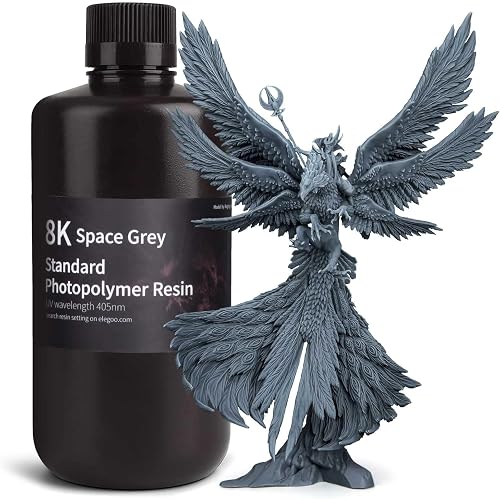 Best for fine miniature detail
ELEGOO Upgraded 8K Standard 3D Printer Resin

Detail and surface finish for miniatures
Resin holds facial features and thin weapons that filament rounds off. The gap is largest on 28 mm to 32 mm figures, where a face is only a few millimeters wide.
Liquid resin cures into shapes set by a high-resolution screen. ELEGOO's 8K resin is built for low shrinkage and high precision, so the print stays close to the model file after curing.
Filament lays down a bead of plastic. A 0.4 mm nozzle sets the smallest line it can draw, so eyebrows, teeth and blade edges lose sharpness.
A smaller nozzle helps, but prints take much longer.
On terrain, the gap narrows. A stone wall or a crate reads fine in filament.
Layer lines can even look like texture once painted.
Where each finish shows up on the table
Think about the parts of a model a player actually sees. A face at arm's length on the table needs clean eyes, a defined nose and a readable mouth.
Resin delivers those shapes because the curing screen resolves them directly. A cloak's folds and a sword's edge also survive because the cured surface stays smooth and the low shrinkage keeps the silhouette true.
Filament's layer lines are horizontal steps. On a flat wall or a crate lid they vanish under paint and primer.
On a cheek or a curved shoulder they catch light and read as ridges. At a 0.1 mm layer height the steps shrink and the figure looks much better, but the print time climbs and the nozzle still softens the finest points.
For a hero figure you plan to paint and show, resin gives the painter more to work with. For a set of dungeon doors or rubble piles, filament's texture works in its favor.
Strength and durability for the table
Filament miniatures survive drops better; resin figures are more brittle. Resin detail comes with a trade-off in toughness.
Cured resin is hard and holds fine edges, but thin ankles, swords and staffs snap under stress. Dropping a resin figure onto a hard floor is a real risk.
PLA prints flex slightly and shrug off bumps. A filament orc that tips over on the table is more likely to bounce than break.
Creality's PLA is made for smooth, clog-free printing and improved toughness.
For pieces that get handled every game night, filament has the edge. For display pieces on a shelf, resin is fine.
Handling and storage habits that matter
How a model lives between games matters as much as the material. A resin figure belongs in a foam tray or a magnetized case, because a loose figure in a bag is the classic way to lose a sword tip.
Thin resin parts also dislike flex, so pack them so nothing presses on a blade or a staff.
Filament pieces tolerate a looser box. Their slight flex absorbs the knocks of a car ride or a crowded shelf.
That toughness is why scenery, tokens and bases that get scooped into a bag favor filament. The Creality PLA bundle's improved toughness and strength suit exactly this kind of functional part.
If your figures are handled by players at every session rather than admired on a shelf, weight the toughness side of the decision more heavily.
Cost, mess and setup at home
Filament is the cleaner, cheaper first printer; resin adds a wash and cure routine. The printer price is only part of the picture.
A resin printer needs resin, gloves, a wash container or station, a cure light and ventilation. A filament printer needs a spool of PLA and a spot for the printer.
That makes filament the easier first step.
Our resin vs filament 3D printer cost guide breaks down the ongoing costs. Resin is consumed per print and needs replacing; filament spools last a long time for small figures.
Resin also brings fumes and skin contact. Uncured resin irritates skin, so gloves and a ventilated room are not optional.
Keep liquid resin away from children and pets.
Space and workflow for each setup
A resin workflow runs in steps. You print, let the part drain, remove supports, rinse it in a wash station or container and cure it under light.
Each step needs a surface you don't mind getting sticky, and the whole routine wants airflow. A spare table near a window or a garage corner suits resin better than a shared desk in a living room.
A filament workflow is shorter. The printer sits on a stable table, the spool hangs on its holder and finished parts come off ready to handle.
Supports come away with pliers and a little sanding finishes the job. A spool like SUNLU's 8.00 inch diameter, 2.20 inch hub design fits many printer holders without an adapter.
If your only workspace is a shared room, the filament routine is the one that stays tidy.
Which printer for figures, terrain and props?
Use resin for character figures and filament for scenery and props. This is the split most painters settle on, and it keeps each printer doing what it does best.
Resin for hero figures and monsters
Resin suits models where the face and silhouette carry the piece. Player characters, named monsters and display busts all reward the sharper detail.
If you're shopping for one, our roundup of the best resin 3D printer for miniatures covers the models worth a look. Pair it with ELEGOO's 8K resin for smooth, precise prints.
Its low viscosity lets it reflow quickly between model and film, which helps the print succeed and trims print time.
Filament for terrain, bases and big props
Filament suits walls, rocks, buildings, barrels and large monsters where toughness matters more than a perfect face. A fast enclosed printer like the Bambu Lab P1S Combo handles scenery quickly and can print in several colors.
Multi-color printing helps terrain stand out without painting. The AMS unit supports up to 16 colors when connected.
The enclosed body also widens the material list beyond PLA, though the listed ideal filaments are PLA, PETG, TPU, PVA, PET, ABS and ASA. Auto bed leveling and a 15 minute setup keep the first print from turning into an afternoon of tuning.
Carbon and glass fiber reinforced polymers are listed as not recommended.
Which filament and resin to start with
Start with a small PLA spool for filament work and an 8K resin for figures. You don't need a cabinet full of materials to begin.
For filament, PLA is the easiest material to learn on. It prints at common temperatures and works on most FDM printers.
Our guide on how to dry 3D printer filament explains how to keep a spool printing cleanly. PLA is also the friendliest filament for a first printer, because it needs no enclosure and forgives small settings mistakes.
Creality's two-spool black and white bundle covers bases and walls without a second order. SUNLU's single black spool is the budget way to keep the printer fed while you practice.
For resin, a standard 8K photopolymer is a sensible start. It balances detail, shrinkage and odor.
Beginners should read our roundup of the best resin 3D printers for beginners before buying. A grey like ELEGOO's Space Grey is also a practical first color, because a neutral base shows detail well under primer and paint.
Plan for gloves from day one; the low odor formula reduces the smell but does not remove the need for ventilation or skin protection.
Who should buy which printer?
Buy a resin printer if figures are your main goal; buy a filament printer if terrain and durability come first. The answer rarely changes once you know your print mix.
Choose resin if you print player characters, monsters and busts and you're happy to wear gloves, wash parts and cure them. Choose filament if you print scenery, want tougher pieces and prefer a dry, simple workspace.
A filament printer is also the better family purchase. There's no liquid resin to store and no wash station to manage.
A resin printer is a focused tool for painters who want the sharpest figures.
If you're unsure, start with filament. It teaches layer height, supports and finishing at lower cost.
Add a resin printer later when figures become the focus. A two-spool PLA bundle makes that practice phase cheap, and a single spool keeps it going once the printer earns its place.
A resin printer is best bought when you already know figures are your main job.
The verdict
Most miniature painters should start with a filament printer and add resin when figures take over. For pure figure quality, the resin vs filament 3D printer for miniatures choice goes to resin.
Pick a resin printer and an 8K resin if your table is built around characters. Pick a filament printer and PLA if terrain, props and durable game pieces fill your games.
The best resin 3D printer for beginners is the next stop if resin wins.
Either way, match the printer to the models you actually print. Detail, toughness, mess and cost all point in the same direction once you know your mix.
Frequently asked questions
Is resin or filament better for D&D miniatures?
Resin is better for hero figures and monsters with faces, weapons and cloaks, because it holds fine detail. Filament suits terrain, bases and bulky props.
If you mostly print player characters, pick resin; if you mostly print scenery, pick filament.
Can a filament printer make good miniatures?
It can make usable miniatures, especially at small layer heights, but fine faces and thin weapons lose sharpness next to resin. Many hobbyists use filament for terrain and a resin printer for the figures on top of it.
Is resin printing safe at home?
Resin printing needs care: uncured resin irritates skin and the fumes should not build up. Wear gloves, keep the room ventilated and keep liquid resin away from children and pets.
Filament is the lower-hassle option for shared living spaces.
How much space does a resin printer setup need?
Budget space for the printer plus a wash and cure step. You need room to remove supports, rinse parts in a container or washing station, and cure them, all with ventilation.
A filament printer needs space for the printer and a spot for finished prints, not a separate wash area.


